
Margaret has lived in Alloa her whole life. She knows the high street, the bridges over the Forth, the particular grey-blue colour of the sky before rain. She raised her children here, watched her grandchildren born here, and when her husband Tommy was diagnosed with a progressive neurological condition four years ago, she did what she had always done with difficulty: she got on with it.
For most of those four years, she told nobody how she was really doing. Her children lived at a distance, her friends had their own troubles, and the healthcare professionals she encountered were focused — understandably — on Tommy. 'Nobody ever asked about me,' she says, without bitterness. 'I don't think it occurred to anyone that I was struggling. I kept the house going. I kept him going. From the outside, I suppose we looked fine.'
"I didn't think of myself as a carer. That word always made me think of paid professionals in a uniform. I was just his wife."
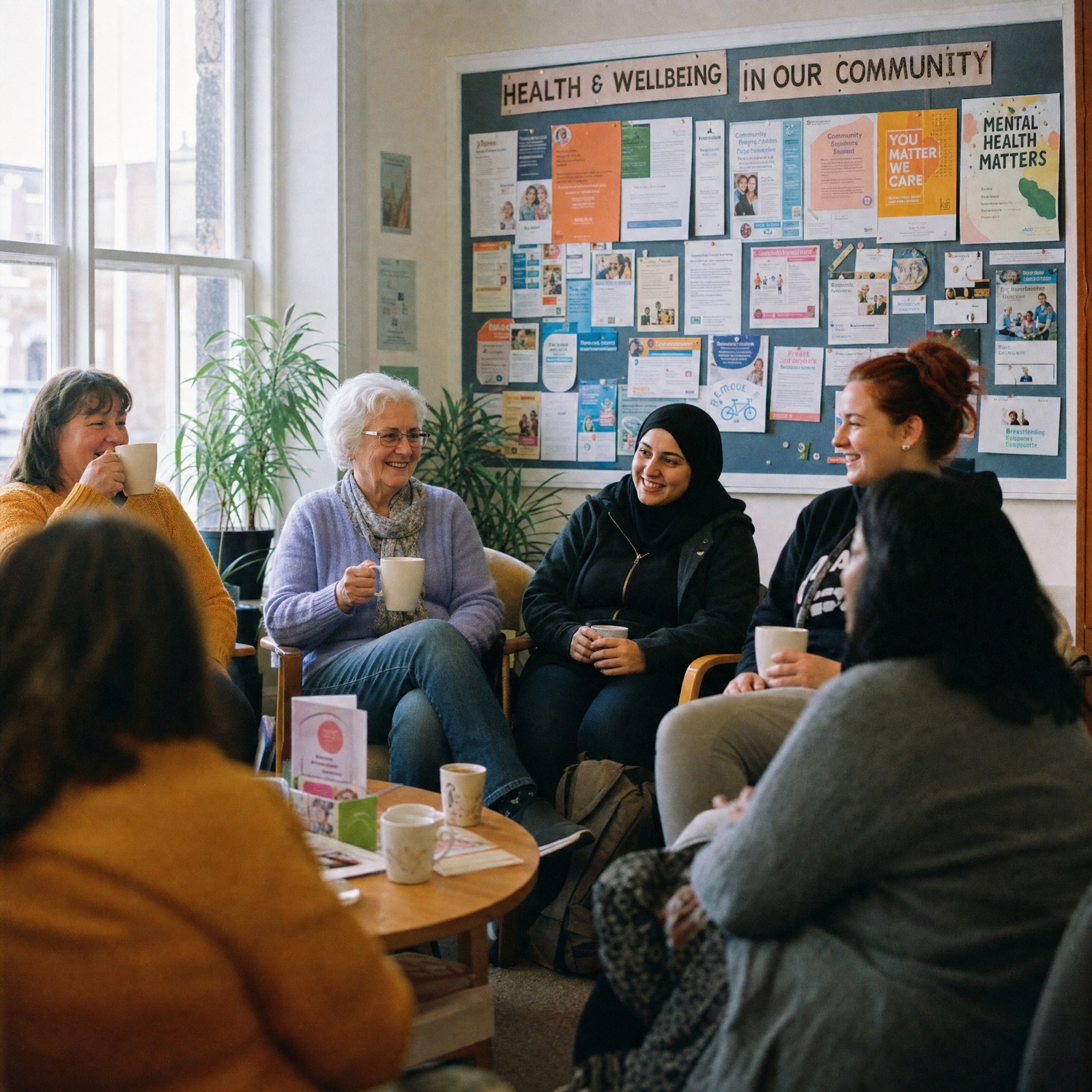
The turning point came at a community event at a local church hall, where a volunteer from Vibrant Health Advocates – Solenne had a table set up with information about unpaid carer support in Clackmannanshire. Margaret almost walked past. 'I didn't think of myself as a carer,' she admits. 'That word always made me think of paid professionals in a uniform. I was just his wife.' The volunteer, recognising something in her expression, asked if she had five minutes. She did.
Within a fortnight, Margaret had been matched with a buddy — a woman in her sixties who had spent eight years caring for her own mother and knew, without needing to be told, the texture of the life Margaret was living. They met first in a café on Mar Street, and Margaret says she cried before her coffee arrived. 'I hadn't talked properly to anyone in so long. She just let me talk. She didn't try to fix it or minimise it. She just listened.'
Through the service, Margaret was also helped to access a Carer Support Plan and to arrange a regular short break — two afternoons a week where a replacement carer comes in and Margaret walks, reads, or simply sits in her garden. Small things. Things she had quietly surrendered years earlier without quite realising it.
Tommy's condition has not improved. The caring role remains demanding, and Margaret is clear-eyed about the road ahead. But she says something has shifted in how she carries it. 'I feel less invisible,' she says. 'I feel like someone knows I'm there.' For those of us who know what invisibility costs, that sentence is not a small one. It is, quietly, everything.